
Organic Growth in Social Media: How to Build a Real Audience in 2026

Okay, so let's talk about something that's probably been bugging you if you run a page for a business in Sri Lanka (or anywhere, really): your posts just aren't reaching people the way they used to.
You post something you're genuinely proud of, and it gets... crickets. Meanwhile a competitor's blurry, half-edited video somehow reaches half of Colombo. Annoying, right?
The most frustrating part is probably that you're not doing anything wrong. Organic growth in social media has genuinely changed shape in 2026, and once you understand why, it stops feeling like a mystery and starts feeling like something you can actually work with.
That's what this guide is for. No jargon-heavy lecture, just a real talk through the numbers, what they mean, and how to use them - simple as that.
The State of Organic Reach in 2026 (Let's Actually Look at the Numbers)
Let's do a bit of quick statistical analysis here, because the raw numbers tell a much more interesting story than "organic reach is bad."
Across the board, Instagram is currently showing posts to somewhere between 3.5% and 7.6% of a page's followers, depending on which benchmark study you look at. That's a huge range, and the reason for it is actually useful: account size matters a lot.
Smaller accounts are seeing reach closer to the 8 - 15% mark, while big accounts over 100,000 followers are stuck down around 3 - 7%.
In other words, the algorithm isn't punishing small pages; if anything, it's currently more generous to them, because it's trying to match relevance rather than reward size.
If you're a small Sri Lankan business worried that you're "too small" to grow organically, that stat should honestly be a relief.
Facebook is a much messier story, however.
Page reach has crashed to somewhere between 1% and 6%, which lines up with what most local SME owners already feel in their gut. But here's the twist: Facebook Groups are pulling in 20 - 40% reach for the same audience size. That's not a small gap, that's a 10x difference.
If you do the maths on a group of 10,000 members, an active group post can land in front of 2000 - 4000 people, while a page post to the same number of followers might only reach a few hundred.
Given that Facebook still has around 9 million users in Sri Lanka and remains the single biggest platform locally, that gap alone should change how a lot of local businesses are thinking about where they post.
Then there's TikTok, which is the biggest hit in the past few years. Engagement rates jumped almost 49% year-over-year to land around 3.70% - miles ahead of Instagram (roughly 0.48%), Facebook (roughly 0.15%), and X (down to about 0.12%).
Statistically, that's not a small edge, that's TikTok operating in a completely different league right now.
Here’s all of the above written jargon in one simple graph;
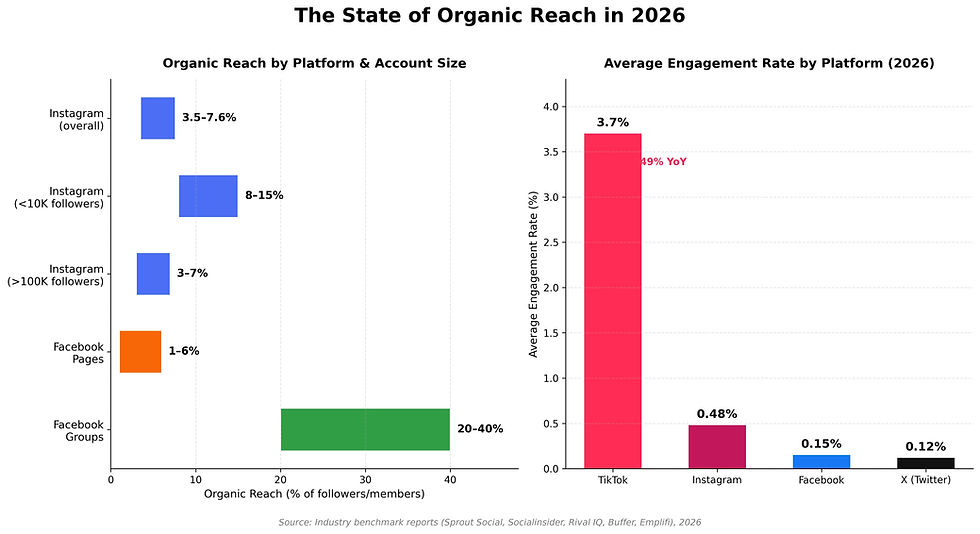
So what's the actual pattern when you zoom out and compare all these numbers side by side? Reach is shrinking almost everywhere content gets filtered by algorithm and follower relationships (Instagram feed, Facebook Pages), but it's holding up wherever content gets filtered by interest and community instead (TikTok, Facebook Groups, niche communities).
That's the real insight buried in the stats: it's not that organic reach died, it's that it moved.
Why Authenticity Beats "Pay-to-Play" Every Time
Think about the last time you actually stopped scrolling. Chances are it wasn't a perfectly lit product shot . It was someone talking straight into the camera, a behind-the-scenes clip, or a comment section that made you laugh.
That's not a coincidence, and it's not just a vibe because it shows up clearly in the data too. Content that feels authentic and emotional consistently beats polished, corporate-style content across almost every industry that's been benchmarked.
Take something like a local bakery page or a small clothing brand from Colombo. The posts that actually take off usually aren't the studio product shots - they're the ones showing the actual baking process, a founder talking about a bad delivery day, or customers tagging themselves wearing the outfit in a GRWM video.
Paid ads can absolutely get you views. What they can't do is build trust, and trust is what makes someone actually message you on WhatsApp to place an order instead of just scrolling past. That's the real difference between renting an audience and owning one.
Core Strategies for Sustainable Organic Growth
Here's what's actually working right now, based on what the data is showing:
Mix your formats.
Short-form video is still strong, generating over double the reach of a plain static image on some platforms. But don't write off carousels because a recent large-scale analysis of over 52 million posts found carousels actually beating reels on engagement in several cases.
Post consistently, not constantly.
The sweet spot right now sits around 5 - 7 posts a week per platform. Go quiet for two weeks and the algorithm forgets about you. Post three times a day and you'll wear out both your team and your audience. It's a rhythm, not a race.
Show up in the first hour.
Posts that get replies within the first 60 minutes see roughly double the total engagement compared to ones that don't. So if you post at 9pm and go to sleep, you're leaving your reach on the table. Post when you can actually be around to reply.
Chase saves and shares over likes.
A like takes zero effort. A save or a share means someone found your content valuable enough to act on it, and the algorithm knows the difference. DM shares in particular carry a lot more weight than a simple like.
Don't sleep on Groups and community spaces.
Given that Facebook Groups are pulling in reach numbers 10x higher than Pages, any local business with a loyal customer base should seriously consider building or actively participating in relevant community groups rather than only posting to their own Page.
Content Pillars: Educate, Entertain, and Empower
If you're stuck on what to actually post, it usually comes down to three buckets:
Educate - teach people something useful and quick.
Entertain - the stuff that makes people stop scrolling. Trends, humour, a bit of chaos behind the scenes.
Empower - this is your customers doing the talking for you. Reposting a happy customer's story, shouting out a loyal regular, showing real reviews. Nothing builds trust in a local market faster than someone recognising a familiar face or name in your content.
Rotate through all three and your page stops looking like a digital pamphlet and starts feeling like an actual personality people want to follow.
Measuring Success Beyond Likes and Follows
Let's talk numbers one more time, because this is where a lot of businesses get it backwards. A page with 50,000 followers and a 0.1% engagement rate is, statistically, weaker than a page with 5,000 followers and a 4% engagement rate.
This is because the second page is actually reaching and moving more of its real audience, even though the follower count looks smaller on paper.
What should you actually be tracking?
Engagement rate by reach tells you how many of the people who actually saw your post cared enough to interact.
Save and share rate tells you whether your content has real value, not just a nice thumbnail.
Comment quality tells you whether you're building a community or just an audience.
And follower growth relative to how much you're posting tells you if you're actually growing efficiently, or just working twice as hard for the same result.
None of these need a fancy dashboard. Most platforms show you this data for free if you just look past the follower count on the homepage.
The Echt Social Approach to Organic Excellence
At Echt Social, this is basically our whole philosophy: organic growth in social media is all about showing up consistently - the boring-sounding stuff that quietly builds real audiences over months, not overnight.
We work with businesses across Sri Lanka to figure out where their actual audience already is and build a content rhythm around that, instead of copying whatever worked for a brand in a foreign country (surprisingly, many people are seriously into this)
We're not anti-paid-ads, by the way. Paid and organic work best together because organic builds the trust, paid can amplify what's already proven to work. But if organic is an afterthought in your strategy, you're building on rented ground.
Heard enough to convince you? Reach out to us today and learn what your brand is missing and let us help you fix it!
FAQs
Is organic social media growth still possible today?
Yes, but the game has shifted. Reach percentages have dropped on algorithm-driven feeds like Instagram and Facebook Pages, but they're holding strong (or even growing) on interest-based platforms like TikTok and community spaces like Facebook Groups. It's less about follower count now and more about actually earning attention with each post.
How long does it take to see results from organic growth?
Realistically, give it 3 - 6 months of consistent posting and community engagement before expecting solid traction. It's slower than paid, but it compounds - a strong organic presence keeps paying off long after you stop actively "growing" it.
What platforms are best for organic reach right now?
Depends on your audience and goals. TikTok currently has the strongest organic engagement numbers overall. Facebook Groups massively outperform Facebook Pages for community-driven local reach; especially useful in Sri Lanka where Facebook remains the biggest platform by far. YouTube and Pinterest work more like search engines, so a good post there keeps working for months.
Should I completely stop paid ads to focus on organic?
No need to go all-in either direction. Organic builds trust and a loyal audience over time; paid can give a proven post an extra push. The strongest approach uses both - organic as the foundation, paid as the accelerator.
How often should I post to maximize organic engagement?
Around 5 - 7 posts a week per platform tends to be the sweet spot right now. Posting less than 3 times a week and engagement drops off noticeably; posting more than 10 times a week gives diminishing returns.


Comments